|
The following information has been sourced from the Australian Bureau of Meteorology. The Bureau is a wonderful resource of weather information, and also contains a wealth of reference material to assist in the research and learning of this most fascinating science. |
|
The Bureau of Meteorology issued its first weather forecast on 1 January 1908. When it was created soon after Federation, the Bureau inherited a service which was a credit to the pioneers of Australian meteorology. In just over 100 years since the first European settlement they had established an observing network over an area larger than Europe, initiated a system of preparing daily weather charts and issuing forecasts, and accumulated a bank of meteorological data.
|
 H.C.Russell, NSW Government Astronomer 1870-1905, outside the Sydney Observatory |
|
First ObservationsObservations of weather conditions around Australia were made by Cook, Dampier and other early navigators. However the first land-based observations were made by William Dawes, a lieutenant in the Royal Marines who arrived with the First Fleet in 1788. He built an observatory at Sydney Cove and for the next three years kept daily records of the wind, temperature, pressure and rainfall. The value of the records was realised from the first days of settlement, and other people, including Governor Arthur Phillip, kept accounts of the weather summarised on a monthly and seasonal basis. From 1800 onwards the expansion of weather information was directly related to the exploration of Australia. Mitchell Oxley, and the trio of Blaxland, Lawson and Wentworth, all compiled valuable weather records as they slowly pushed back the frontiers of settlement.
|
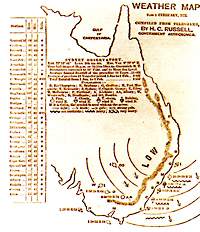
First weather
chart published |
|
Observations in New South WalesSir Thomas Brisbane, appointed governor of New South Wales in 1821, established an observatory at Parramatta which made systematic observations from 1822-1826. Educated convicts were appointed to take observations at South Head and Port Macquarie, for which they received an allowance of one shilling and sixpence per day.
Developments in Other Colonies Facilities for gathering meteorological observations in the other colonies developed in parallel with, but separately from, those in New South Wales. Melbourne's first observatory was built at Williamstown, in 1854.1n 1856 a Bavarian scientist and ship's officer, Georg von Neumayer, established an observatory at Flagstaff Hill (now the Flagstaff Gardens). He also organized a number of observing stations throughout Victoria and in 1859 his efforts were rewarded with appointment as Victoria's government astronomer. Neumayer was succeeded in 1863 by R.L.J. Ellery who published Melbourne's first newspaper weather map in 1881. In South Australia rainfall records were kept from 1839, but the major impetus to a meteorological service was given by the arrival of Sir Charles Todd in 1855, as Director of the Adelaide observatory. Todd was better known as Postmaster General and the man responsible for the completion of the famous Adelaide to Darwin overland telegraph in 1872. He seized the opportunity to gather meteorological information and made it a duty of all his telegraph operators to observe, collect and dispatch weather reports. In Western Australia the first daily observations were taken at Fremantle from 1852 -55 and a government observatory was established in 1876 under the direction of the Surveyor-General, Sir Malcolm Frazer. The Royal Society in England was responsible for establishment of an observatory at Hobarton (now Hobart) in Van Diemen's Land, which operated from 1841-1855 In the Northern Territory the earliest observations were made at Port Essington in 1834, and regular daily observations began at Port Darwin in 1869.
|
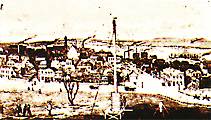 View of Melbourne from Flagstaff Hill late 1850s Meteorological stand is in the foreground. |
|
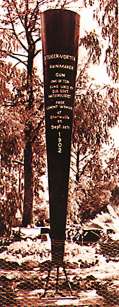 |
One of the six "rainmaker guns" used by Queensland Govt. meteorologist Clement Wragge in an unsuccessful attempt to break a drought in 1902. | |
|
Perhaps the most colourful of the early Australian meteorologists was Clement Wragge, Queensland government meteorologist from 1887 - 1903. A man of great energy and enthusiasm, he established a network of observing stations throughout Queensland, as well as observatories on Mount Wellington, near Hobart, and Mount Kosciusko. Wragge pioneered the practice of naming cyclones, using letters of the Greek alphabet, characters from Greek and Roman mythology, and even names of local politicians. A growing realisation of the benefits of cooperation and uniformity between the colonies in meteorological matters led to the first conference of government astronomers in 1879, followed by further meetings in 1881 and 1888.
Development of the Bureau of MeteorologyA
Bill to establish the Commonwealth Bureau of Meteorology was introduced in
1906, and operations began in 1908 under H.A. Hunt, the first Commonwealth
Meteorologist. Early services consisted of one daily forecast for the
States, metropolitan areas and oceans. Although it operated Australia wide,
the Bureau for many years worked with very limited staff and resources. The threat of war in the late 1930s saw a marked increase in the requirements for rneteorological services. Staff numbers jumped dramatically, and training courses for meteorologists and observers were introduced. In 1941 the Bureau was incorporated in the Royal Australian Air Force for the duration of the war. The post war period was one of great expansion in the Bureau, particularly during the 1950s and 60s. It was an era that saw the first use of radar for upper wind measurement (1948), Australia become one of the first members of the World Meteorological Organizations (1950), the start of continuous meteorological observations at Mawson station in Antarctica (1954), the first television weather broadcast (1956), the first automatic weather station (1962), reception of the first TIROS satellite picture (1964), introduction of computers (1968), regular transmissions begin from the Japanese geostationary satellite (1978), and introduction of a computerised communications system (1979).
|
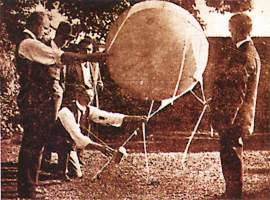
Balloon launch by Sydney meteorological staff 1914.
|
|
|
© Copyright Commonwealth of Australia 2007, Bureau of Meteorology (ABN 92 637 533 532) |
||